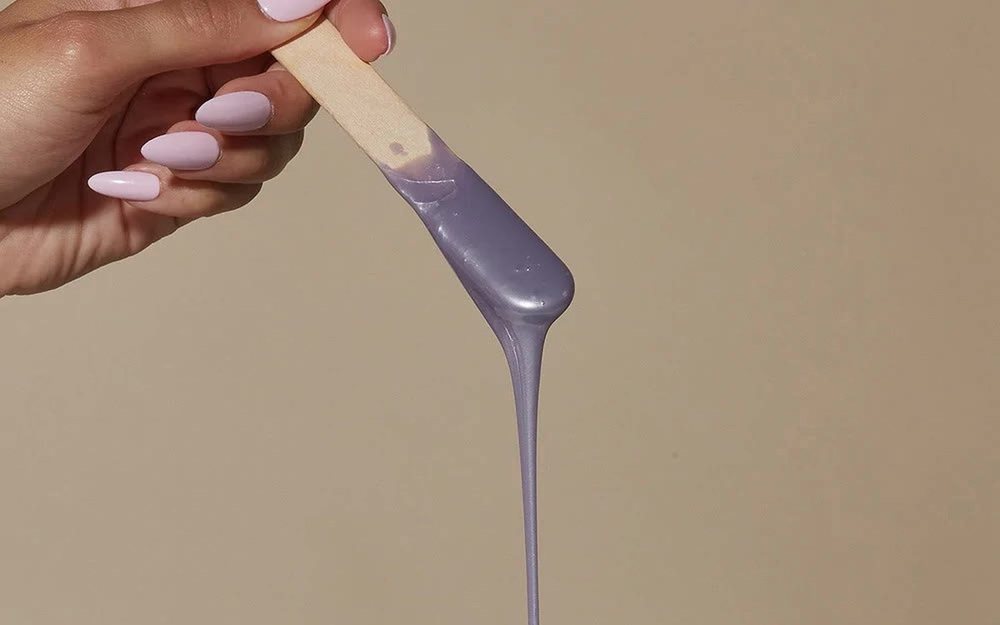
What rosin contributes, and what replaces it
Rosin has historically served as a tackifier and a contributor to film flexibility. Take it out and the formulator has to rebuild those properties with a combination of polymers, waxes and plasticising components.
That is the substantive part of a rosin-free project. It is also why "rosin-free" alone tells you very little about how a product will perform — two rosin-free formulas can behave completely differently.
The polymer balance
The polymer system determines how the film forms, how much it grips and how it releases. Too much grip and the film tears; too little and it fails to pick up finer hair. Film flexibility determines whether the wax can be used on a curved area.
This is where sample evaluation is genuinely irreplaceable. Published properties cannot tell you how a formula feels on a jawline.
Skin safety claims, stated precisely
Rosin-free is an ingredient profile. It is not a hypoallergenic claim, not a sensitive-skin claim, and not a statement that a reaction cannot occur. Any of those claims require their own evidence, and most cosmetic regulations require that evidence to exist before the claim is published.
The defensible position is to describe the formula accurately, provide the ingredient declaration, and give clear patch-test guidance for professional use.
Documentation the supplier should hold
Ask for the ingredient declaration, the safety assessment position for the intended market, batch coding method, shelf life and storage conditions. Ask whether the formulation has changed and, if so, when.
A formulation change is legitimate. The problem is a formulation change that nobody told you about, because your approved sample and your production batch no longer match.
Designing a validation test
Run the candidate formula on a controlled set of services with a fixed heater setting and a fixed room condition, and record how the film behaves at the point of removal. Repeat on a second day to check repeatability.
Compare directly against the formula you are replacing. A new product only has to be better than the one you already sell, not perfect in the abstract.
Rosin-free is a formulation decision with real consequences. It is not a skin-safety claim, and the copy should never suggest otherwise.
In short
- Understand that removing rosin requires reformulating, not just omitting.
- Judge the polymer system by how the film behaves at removal.
- Never publish rosin-free as an allergy or sensitivity claim.
- Ask whether the formulation has changed and when.
- Benchmark every candidate against the product you already sell.
T
TecoProduct development, BeauTome. Writes on formulation, sourcing and equipment specification for beauty brands.

 3 min