Temperature stability across a cycle
A heater reaches its set temperature and then does something while it waits. A well-designed unit holds close to the target with small, infrequent corrections. A poorly designed one overshoots, drops, and overshoots again.
That oscillation is what technicians experience as wax that is "sometimes too runny". It is measurable, and a manufacturer with a test bench can produce the curve.
Sensor placement
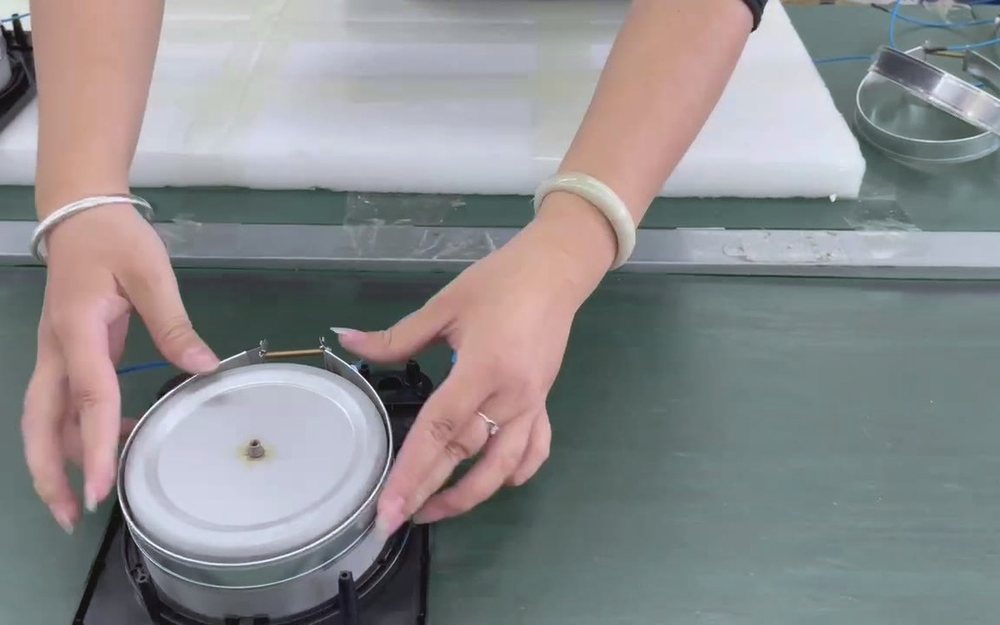
The sensor only reports what it can feel. A sensor near the element reads element temperature; a sensor in contact with the pot wall reads something closer to the wax. The difference between those two readings explains why two heaters set to the same number produce different wax.
Ask where the sensor sits and whether the control acts on the sensor reading alone or on a model of the pot behaviour.
Control logic
Simple controllers switch the element on and off around a threshold. Better ones modulate the duty cycle to reduce overshoot. The visible difference is how the wax behaves during a long service, not immediately after switching on.
This is where a digital display earns its place, because it lets the operator see what the controller is doing rather than guessing.
Heat distribution
An element in one place and wax everywhere means the wax is heated by conduction and convection. Pot geometry, wall thickness and whether the pot is fixed or removable all affect how evenly that happens.
A removable pot usually heats through the base only. That is not automatically worse, but it does change how much stirring is needed and how long the wax takes to reach even consistency.
Safety architecture
Ask about dry-run protection, thermal cut-out, fuse arrangement and the rating of the power assembly. Then ask what happens during a single-fault condition rather than assuming it has been considered.
Good safety design is not visible on the outside of the product, which is exactly why it is worth asking about before you order.
Ask where the sensor sits. The answer tells you most of what you need to know about how the thing will feel in daily use.
In short
- Request the temperature stability curve, not just a range.
- Find out where the sensor is mounted.
- Prefer duty-cycle control over simple on/off switching.
- Understand how pot construction affects heat distribution.
- Ask for dry-run and thermal cut-out details.
T
TecoProduct development, BeauTome. Writes on formulation, sourcing and equipment specification for beauty brands.


 4 min